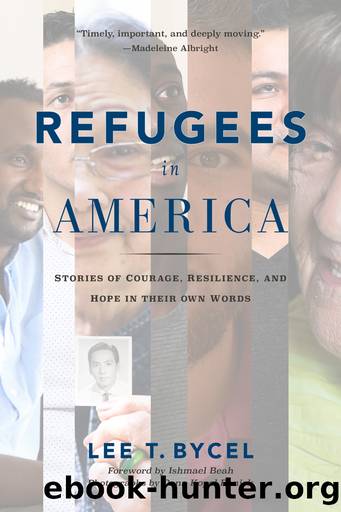
Refugees in America: Stories of Courage, Resilience, and Hope in Their Own Words by Lee T Bycel
Author:Lee T Bycel [Bycel, Lee T]
Language: eng
Format: epub
Tags: Emigration & Immigration, Public Policy, United States, Social Science, Political Science, World, Immigration, History, 21st Century, General, Human Rights
ISBN: 9781978806214
Google: 3MMtwQEACAAJ
Goodreads: 44451649
Publisher: Rutgers University Press
Published: 2019-09-13T00:00:00+00:00
CHAPTER 7
VANNY LOUN
CAMBODIA
I remember an old man saying to my mum: âYou know when your house gets robbed, you still have a house, you still have furniture. But when your house gets bombed and burnt, you donât have anything. You are homeless, you are just lucky to be alive.â Since that day, I never saw my village, but I always wanted to go home. My mum never took me back.
Like so many other Cambodians, Vanny Loun saw her house and life destroyed by the genocidal actions of the Khmer Rouge (the army of the Cambodian Communist Party) in the last half of the 1970s. But the area that is now called Cambodia has a centuries-old history as an important trade route linking China to India and Southeast Asia. The kingdoms of Cambodia were influenced by many cultures and enjoyed centuries of prosperity followed by hundreds of years of suffering and demise. In more recent years, Cambodia gained its independence from France in 1953 but was never really able to emerge into a free and vibrant society. During the Vietnam War, Cambodia tried to remain neutral, but the United States felt that the Vietcong were using the Cambodian countryside as staging areas for attacks. In the early 1970s the United States embarked on a long period of heavy bombing in Cambodia, killing well over a hundred thousand people.
The end of the Vietnam War and the heavy toll that Cambodia experienced during this era gave rise to the brutal guerrilla movement of Pol Pot and the Khmer Rouge regime. His goal was to create an agrarian socialist society. The regime seized complete power of the country in 1975 and instituted a series of measures that were intended to indoctrinate a new generation of Cambodians. The people were promised a utopian society where everyone would be equal and prosper. However, that dream was quickly shattered when the Khmer Rouge isolated itself from the world, expelled all foreign media, and embarked on a four-year-long genocide from 1975 to 1979. Money, schools, companies, hospitals, and the basic underpinnings of modern society were made obsolete. Doctors, lawyers, bankers, educators, and intellectuals were the first to be exterminated and forced into exile. Millions of Cambodians were forced out of cities to work on collective farms under brutal conditions. Many of these people died from starvation, executions, forced labor, and basic diseases that could no longer be treated since all of the doctors had been exterminated. To put the sheer horror and magnitude of this atrocity into perspective, an estimated 21 percent of the countryâs population, about 1.7â2 million Cambodians, was killed during the Khmer Rougeâs four years in power. The groups most targeted in the genocide were Buddhists, Muslims, Christians, ethnic Chinese, Vietnamese, Thai, and Cambodians with Chinese, Vietnamese, or Thai ancestry.
Finally, in 1979, Vietnam liberated Cambodia from the brutal regime of the Khmer Rouge. The genocide ended, but for many of the survivors, like Vanny, the horrors did not. The peaceful world of their childhood had been destroyed, leaving them scarred and traumatized for years to come.
Download
This site does not store any files on its server. We only index and link to content provided by other sites. Please contact the content providers to delete copyright contents if any and email us, we'll remove relevant links or contents immediately.
Cecilia; Or, Memoirs of an Heiress — Volume 1 by Fanny Burney(32558)
The Great Music City by Andrea Baker(32020)
Cecilia; Or, Memoirs of an Heiress — Volume 2 by Fanny Burney(31956)
Cecilia; Or, Memoirs of an Heiress — Volume 3 by Fanny Burney(31942)
We're Going to Need More Wine by Gabrielle Union(19049)
All the Missing Girls by Megan Miranda(16032)
Pimp by Iceberg Slim(14509)
For the Love of Europe by Rick Steves(14124)
Bombshells: Glamour Girls of a Lifetime by Sullivan Steve(14077)
Talking to Strangers by Malcolm Gladwell(13371)
Norse Mythology by Gaiman Neil(13370)
Fifty Shades Freed by E L James(13243)
Mindhunter: Inside the FBI's Elite Serial Crime Unit by John E. Douglas & Mark Olshaker(9344)
Crazy Rich Asians by Kevin Kwan(9293)
The Lost Art of Listening by Michael P. Nichols(7506)
Enlightenment Now: The Case for Reason, Science, Humanism, and Progress by Steven Pinker(7314)
The Four Agreements by Don Miguel Ruiz(6765)
Bad Blood by John Carreyrou(6623)
Weapons of Math Destruction by Cathy O'Neil(6281)
